
80%
AI and Generative AI Adoption Accelerates in Enterprise Ecommerce
80% of enterprise ecommerce organizations adopt or explore AI and generative AI within their ecommerce platform.
ENTERPRISE COMMERCE RESEARCH · PREPARED FOR ADOBE · Nov 18, 2026
2026 strategies for ecommerce platform modernization, AI adoption, and personalization
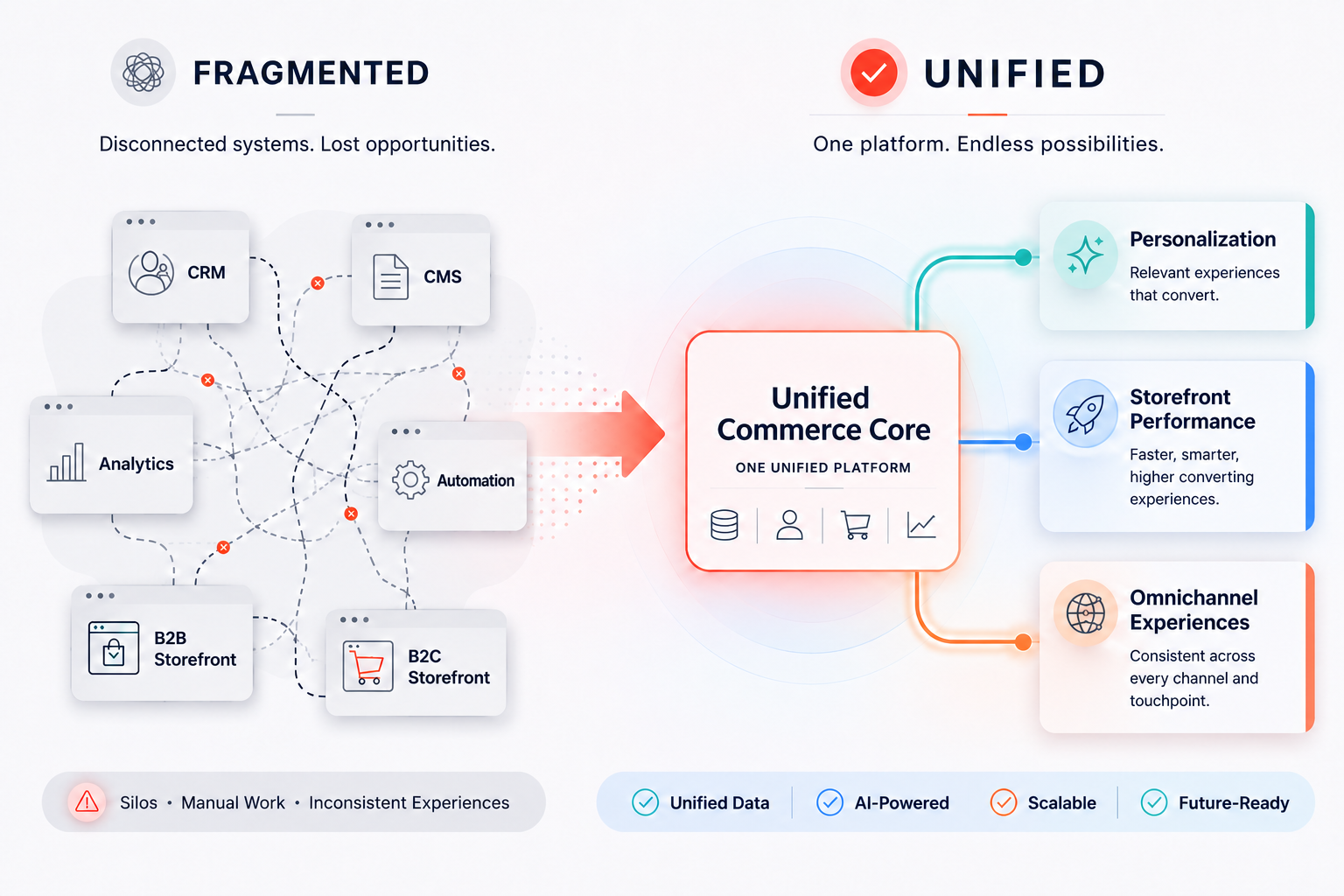
Fragmented b2b ecommerce platforms merge into one enterprise ecommerce platform, built for personalization at scale.
We spoke with 100 enterprise ecommerce decision-makers. Our questions were direct: how are you rethinking your ecommerce platform, scaling ecommerce personalization, and improving the customer experience? The answers show what separates the brands pulling ahead from everyone else.
Enterprise ecommerce is transforming at every level: technically, operationally, culturally. AI now touches personalization, content, and internal workflows. At the same time, brands modernize their enterprise ecommerce platform for scale and integration, and many eye a broader omnichannel commerce platform approach.
Leaders want real-time data activation, consistent omnichannel experiences, and flexible, future-ready architecture. Five shared challenges surfaced across the interviews:
The enterprise ecommerce landscape has not moved this fast before. Buyers, in both B2C and B2B markets, now expect seamless, personalized ecommerce experiences and consistent service at every touchpoint. Leading brands deliver on that expectation and collect the reward: more loyalty, higher engagement, more revenue. For many others, delivering these experiences at scale across a modern ecommerce platform stays out of reach.
The roadblocks sound familiar. Fragmented data. Unclear ROI models. Limited internal expertise. Brand leaders need clear implementation pathways and deployment strategies that scale, and that balance innovation with oversight. Concerns about over-automation and loss of control persist, especially where AI touches the customer directly.
Organizations face growing pressure to drive more revenue through digital channels while staying agile across geographies, product lines, and customer segments. Scaling a modern enterprise ecommerce platform takes more than ambition. It takes smarter architecture, integrated data, and the right application of AI, pointed toward an AI ecommerce platform built for what comes next.
Demand is not the problem. Execution is. Several structural challenges stand between organizations and the digital commerce experience their customers expect.
Ecommerce platform migration and modernization pressures. Legacy ecommerce platforms increasingly look like barriers to agility, not foundations for it. End-of-life systems and rising support costs push many brands toward migrations to modern, cloud-native ecommerce platforms. Migration is no small feat, though. These transitions bring technical complexity, operational risk, and real investment. For brands that want to move quickly, success means choosing a platform that minimizes disruption while it supports long-term flexibility, integration, and growth.
AI implementation and scaling complexity. Commerce teams see AI as a critical driver of efficiency and personalization within their ecommerce platform. It powers content creation, product recommendations, search, and automation, at least on paper. Intent is strong. Execution lags. Most teams remain at the early stages of adoption.
Ecommerce personalization at scale. Personalization moved from competitive differentiator to baseline customer expectation. Yet 52% of enterprise organizations remain in early-stage personalization rollout, and delivering personalization across millions of customers, multiple brands, and diverse channels stays out of reach for most.
Integration and data unification requirements. Modern commerce runs on a patchwork of systems: CRM, analytics, CMS, automation. Making them work together is the real challenge. Leading brands prioritize ecommerce platforms with strong APIs, built-in connectors, and data activation capabilities that unify the customer journey across teams and channels.
Omnichannel commerce platform and multi-brand scaling challenges. Brands now operate across multiple geographies, audiences, and channels, all while holding onto a distinct experience per brand. Scaling an omnichannel commerce platform demands infrastructure that balances centralization with flexibility, particularly in inventory, pricing, and personalization.
Put these five challenges together and the tension is clear. Brands understand what their customers expect. Many still lack the integration, speed, and cross-functional coordination to deliver it at scale.
Delivering ecommerce personalization at scale. Consumers made their preferences clear years ago. According to McKinsey, 71% of consumers expected personalization across digital touchpoints back in 2021, and 76% felt frustrated when brands missed the mark. Companies with faster revenue growth derive 40% more of that revenue from personalization than their slower-growing peers. Most organizations still struggle to turn that into practice: data silos, legacy systems, and sheer customer-data volume make real-time action difficult. Brands recognize that automation, AI, and integrated data strategies matter for delivering ecommerce personalization at scale, but many remain early in that journey. McKinsey's 2025 research points to one concrete result: a North American retailer generated $400 million from pricing improvements plus another $150 million from gen AI-enabled targeted offers, in a single year.
Building differentiated and high-performing storefronts. Your storefront is your flagship now, post-COVID. High-performing storefronts moved from nice-to-have to mission-critical for enterprise ecommerce brands. Organizations need storefronts that are fast, flexible, and built to convert, with the ability to test, iterate, and evolve the experience quickly. Increasingly, brands turn away from third-party marketplaces toward their own digital storefronts, where they control the experience, capture customer data, and keep more margin.
Addressing the rising demands of B2B ecommerce. B2B ecommerce represents a $32.1 trillion market opportunity, according to data from Capital One Shopping. Buyers expect the same self-service convenience in B2B that they already get in B2C: 24/7 ordering, personalization, seamless purchasing flows. For businesses running both B2B and B2C, the challenge compounds. Complex business models often demand costly customization, sometimes even multiple B2B ecommerce platforms. Without the right enterprise ecommerce platform foundation, these complexities slow growth, inflate costs, and limit agility.
80% of enterprise ecommerce organizations adopt or explore AI and generative AI within their ecommerce platform.
44.7% of organizations migrate or plan to migrate their ecommerce in order to scale.
52% of enterprise ecommerce organizations sit in the early stage of their B2C or B2B ecommerce personalization rollout.
62% of organizations manage both B2B and B2C requirements within a single ecommerce platform.
83% of organizations prioritize storefront performance and content optimization.
89% of organizations require omnichannel commerce platform capabilities for a unified customer experience.
Ecommerce teams see AI as a critical driver of efficiency and personalization: it powers content creation, product recommendations, search, and automation. Intent is strong. Adoption is not. Most teams remain at an early stage.
Enterprise ecommerce organizations actively implement or explore AI and generative AI capabilities across their ecommerce platform. Clear patterns emerge around adoption maturity and strategic focus.
Early-Stage AI Adoption with Interest in Generative AI (54.8%): Organizations exploring AI capabilities with strong interest in generative applications.
Active AI Adoption with Generative AI (24.7%): Companies with established AI implementations actively using generative AI tools.
Limited or No AI Adoption (20.4%): Organizations with minimal current AI usage but potential for future adoption.
AI stopped being experimental. It is now foundational to enterprise ecommerce platform development, even with 54.8% of organizations still early in adoption and not yet operating at scale. Brands need clear implementation plans built around defined use cases, starting where AI delivers immediate value: content creation, product search, automation. Balance innovation with practical ROI. Make sure AI tools enhance ecommerce personalization and the customer experience. They should never replace it.
Legacy commerce platforms increasingly look like barriers to agility. End-of-life systems and rising support costs push many brands toward migrations to modern, cloud-native platforms.
Organizations actively migrate their ecommerce platform, or plan to, driven by clear scalability needs.
Scalability and Integration Needs (44.7%): Migrations driven by need for scalability, ERP integration, and faster time-to-market from legacy ecommerce platforms.
Cost and Usability Considerations (32.5%): Platform changes driven by usability limitations, support challenges, and cost optimization needs.
Modernization and Flexibility (22.8%): Strategic moves toward modern architectures, microservices, and flexible deployment capabilities.
"We were on a homegrown legacy system, which was very out of date. It was a long time coming, and it was much needed."
Minimize disruption. Select an ecommerce platform with proven migration paths, a strong support model, and clear business value. Success depends on planning for flexibility, reducing risk, and building a new enterprise ecommerce platform architecture that aligns with where the business is headed, not just where it stands today.
Personalization moved from competitive differentiator to customer expectation. 52% of enterprise organizations remain in early-stage personalization development.
52% of ecommerce organizations sit in the early stages of implementing personalization, and delivering personalization across millions of customers, multiple brands, and diverse channels stays out of reach for most.
Limited or Basic Personalization (48.4%): Organizations with manual processes and basic personalization capabilities, representing a significant growth opportunity.
Emerging Personalization Capabilities (17.6%): Companies developing real-time personalization with current limitations but strong potential.
Active Implementation and Adoption (17.6%): Organizations with established AI-driven personalization across channels and ongoing optimization.
Strategic Priority with Challenges (16.5%): Companies that recognize personalization as critical but face data integration and execution challenges.
Intent alone will not scale ecommerce personalization. It takes unified data, cross-functional coordination, and the right technology. Build a roadmap that matches your maturity level, and prioritize systems built for real-time execution and measurable business impact.
B2B ecommerce represents a $32.1 trillion market opportunity. Buyers expect the same self-service convenience in B2B that they already get in B2C.
Organizations increasingly run dual B2B and B2C models. That creates complex platform requirements and a demand for a unified experience.
Dual B2B and B2C Models (61.9%): Organizations supporting both business models on unified or integrated platforms with complex multi-segment requirements.
B2C-Focused Requirements (17.5%): Primarily consumer-facing organizations with a direct-to-consumer focus and minimal B2B needs.
B2B-Focused Requirements (14.4%): Enterprise organizations operating a dedicated B2B ecommerce platform, with complex workflows, self-service portals, and industry-specific pricing.
Inconclusive (6.2%): Organizations with unclear or unspecified business model requirements.
Managing both models introduces real complexity across pricing, workflows, and user experience. Prioritize an enterprise ecommerce platform built to support both models within one architecture, one that unifies data, runs operations efficiently, and keeps customer engagement consistent.
Your ecommerce storefront is your flagship, post-COVID. High-performing storefronts moved from nice-to-have to mission-critical for growth.
83% of organizations actively focus on storefront performance and AI-driven content creation, with close to equal weight on both.
AI-Driven Content Creation and Personalization (42.7%): Organizations leveraging AI for content generation, visual optimization, and personalized storefront experiences.
Storefront Performance and Optimization (40.6%): Companies prioritizing site performance, user experience enhancement, and conversion optimization.
Limited or Non-Applicable Focus (16.7%): Organizations with minimal current focus on advanced storefront capabilities or content creation.
Brands now compete on experience, which makes AI-driven content and performance optimization essential, not optional. Look for tools that improve conversion rates, simplify workflows, and personalize storefronts while supporting faster, more flexible content delivery.
Brands now operate across multiple geographies, audiences, and channels, all while holding onto a distinct experience per brand.
89% of organizations require omnichannel and unified commerce capabilities. Integration complexity drives most platform architecture decisions.
Limited or No Omnichannel Strategy (63.7%): Organizations with minimal cross-channel coordination or unified commerce capabilities.
Unified Customer Experience Focus (14.3%): Companies prioritizing consistent customer experiences across touchpoints.
Implicit Omnichannel Presence (13.2%): Organizations with some cross-channel capabilities but no explicit omnichannel strategy.
Explicit Omnichannel Strategy (8.8%): Companies with defined omnichannel strategies and comprehensive cross-channel integration.
Omnichannel execution sits at the top of the priority list, and it comes with real complexity. Look for an omnichannel commerce platform that unifies data, holds consistency across touchpoints, and supports real-time updates. Strong integration and operational flexibility deliver the seamless experience customers now expect by default.
Six core findings reveal the most urgent challenges and motivations shaping enterprise commerce today. The five themes below show how leading brands respond: where teams invest, experiment, and build the foundation for future growth.
63.3% of organizations focus their ROI measurement on conversion and revenue growth over operational metrics.
Conversion and Revenue Growth (63.3%): Focus on revenue-driven optimization and sales growth.
Operational Efficiency and Process Improvement (28.8%): Back-end efficiency gains and cost management.
ROI and Business Impact (7.9%): Comprehensive commerce metrics and business impact measurement.
Conversion and revenue growth win the attention of ecommerce leaders because these metrics tie directly to sales. Measure performance against outcomes that connect to growth. Operational efficiency matters, but it is not the whole story.
43.8% of organizations show only basic or partial marketing-commerce integration. Partial implementations outnumber comprehensive ones by a wide margin.
Basic or Partial Integration (43.8%): Implementation obstacles and partial system connections.
Strong Integration and Strategic Priority (32.3%): Comprehensive system unification and strategic focus.
Limited or No Evidence of Integration (24.0%): Minimal integration capabilities or evidence.
Most brands still run on partial or disconnected systems. Prioritize an ecommerce platform that supports seamless data flow and tighter integration between marketing and commerce systems, and performance and customer experience follow.
77.3% of organizations prioritize data utilization for personalization over governance or privacy concerns.
Data Utilization for Personalization (77.3%): Customer-centric data activation and personalization focus.
Lack of Explicit Data Strategy (20.6%): Minimal or unclear data strategy approach.
Data Ownership and Privacy Concerns (2.0%): Comprehensive data governance and privacy compliance.
The priority has shifted from ownership to outcomes, now that most brands focus on activating customer data. Invest in platforms that make data easier to unify, access, and act on in real time. That is what enables ecommerce personalization and a better customer experience.
50.5% of organizations manage complex multi-brand and multi-market operations, which creates substantial requirements for their ecommerce platform.
Complex Multi-Brand and Multi-Market Management (50.5%): Complex multi-entity management and scaling challenges.
Single Brand or Limited Multi-Brand Focus (29.0%): Primarily single-brand operations with limited multi-brand complexity.
No Evidence or Limited Information (20.4%): Insufficient evidence of multi-brand operations.
Managing multiple brands and markets adds real operational complexity. Look for an enterprise ecommerce platform built for centralized control with the flexibility to localize experiences, manage distinct brand needs, and hold consistency across markets. That combination scales.
47.3% of development teams prioritize operational efficiency and automation over development flexibility.
Operational Efficiency and Automation (47.3%): Process efficiency focus and automation priorities.
Time-to-Market and Deployment Speed (22.0%): Time-to-market optimization and deployment efficiency.
Platform Flexibility and Integration (18.7%): Development agility focus and platform customization.
Developer Experience and Productivity (12.1%): Development environment optimization and productivity tools.
Improving operational efficiency is a top priority for development teams. Brands should evaluate platforms that reduce manual effort, support faster deployment, and simplify workflows, so technical teams move quickly without sacrificing stability or control.
AI stopped being experimental. It is now foundational to enterprise ecommerce platform development, even with 54.8% of organizations still early in adoption and not yet operating at scale. Brands need clear implementation plans built around defined use cases, starting where AI delivers immediate value: content creation, product search, automation. Balance innovation with practical ROI. Make sure AI tools enhance ecommerce personalization and the customer experience. They should never replace it.
Minimize disruption. Select an ecommerce platform with proven migration paths, a strong support model, and clear business value. Success depends on planning for flexibility, reducing risk, and building a new enterprise ecommerce platform architecture that aligns with where the business is headed, not just where it stands today.
Intent alone will not scale ecommerce personalization. It takes unified data, cross-functional coordination, and the right technology. Build a roadmap that matches your maturity level, and prioritize systems built for real-time execution and measurable business impact.
Managing both models introduces real complexity across pricing, workflows, and user experience. Prioritize an enterprise ecommerce platform built to support both models within one architecture, one that unifies data, runs operations efficiently, and keeps customer engagement consistent.
Brands now compete on experience, which makes AI-driven content and performance optimization essential, not optional. Look for tools that improve conversion rates, simplify workflows, and personalize storefronts while supporting faster, more flexible content delivery.
G2 Research
This report was prepared by G2 AI Custom Research for Adobe.
This research draws on structured interviews with 100 enterprise commerce decision-makers representing a wide mix of roles, industries, and company sizes. Participants included executives, directors, managers, and technical specialists spanning 21.5% Commerce Decision Makers, 20.6% Marketers, 14% E-commerce Leaders, 14% IT Leaders, 11.2% Enterprise Commerce Leaders, 10.3% Commerce Professionals, 8.4% Merchandisers.
The sample reflects a balanced view of the enterprise commerce ecosystem, with organizations ranging from mid-sized firms (100-999 employees) to large global enterprises (1,000+ employees). Industry coverage included retail, B2B services, manufacturing, healthcare, and technology, with a geographic distribution spanning North America.
The analysis of 100 interview transcripts was conducted using AI for semantic understanding, with multi-iteration validation and cross-verification to ensure a 97.0% analysis success rate and confidence scoring. Each transcript was reviewed and formatted by G2's AI Solutions team to inform narrative, context, and clarity.
G2, Transforming Enterprise eCommerce: Strategies for AI Adoption, Personalization, and Platform Modernization, 2025.
This article was originally published in June 2026 and updated in November 2026.
Sponsored
Take the next step in your enterprise ecommerce planning. Explore Adobe Commerce alongside the priorities highlighted in this report: AI adoption, personalization, and platform modernization.
This research was commissioned by Adobe.
Explore more original research, selected from our latest reports.
AI agents can already buy from three in ten online sellers we spoke to. Most of those sellers can't reliably see the agents, and many run checkout defenses that would turn them away.
G2 research with 100 UK business decision-makers finds 77% run largely disconnected software estates, 90% flag security exposure, and only 7% can quantify AI ROI.
Agentic voice AI in 2026: G2 interviewed 359 leaders. 82% of live deployments report positive ROI, 92% run with high or partial autonomy.