
34%
Agent Walk-Aways Leave No Signal
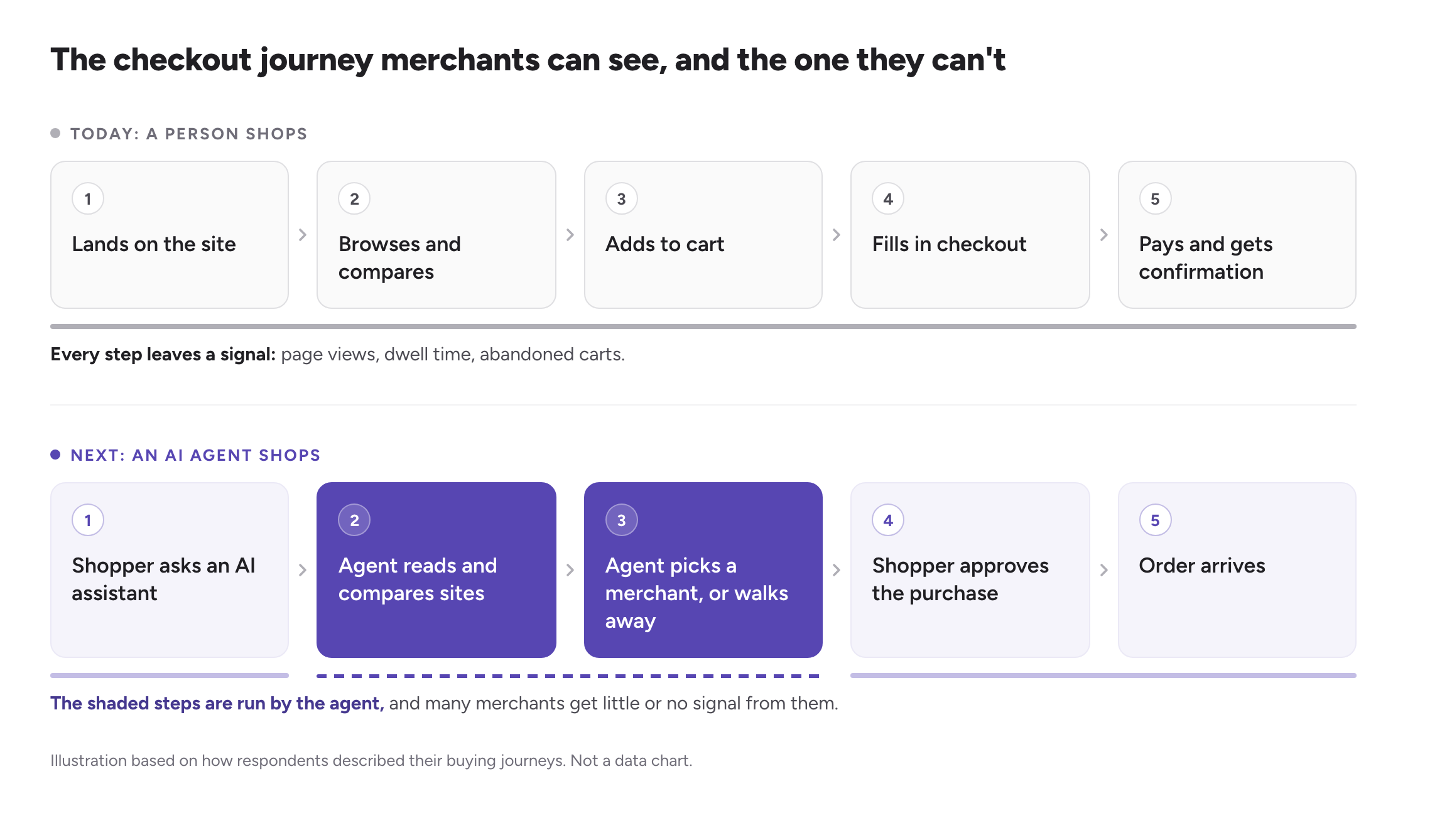
When an agent looks at a business and buys elsewhere, a third of merchants would see no signal at all. Cart abandonment has a successor that most merchants can't yet see. (Base: 157 online sellers.)
Agentic Commerce Merchant Study 2026 · Nov 19, 2026
AI agents can already buy from three in ten online sellers we spoke to. Most of those sellers can't reliably see the agents, and many run checkout defenses that would turn them away.
Agentic commerce is online buying where an AI agent, sometimes called an AI shopping assistant, finds, compares and pays for products on a person's behalf.
G2 interviewed 206 senior commerce leaders across the US, UK and Europe, all screened to director level or above and half of them C-suite executives, founders or VPs, including 52 leaders at companies with more than 1,000 employees. The interviews, held in October 2026, focused on AI agents that buy on a customer's behalf. Among the 169 who sell online, 29% say agents can already complete purchases with them, yet only 12% of that group can reliably tell an agent's order from a human's. A third (34%) run bot checks, fraud rules or authentication steps they expect would stop an agent at checkout, while just 2% expect checkout friction to cost them an agent sale. Few expect the checkout to vanish: 56% say it will survive as a human confirmation step, and only 9% expect cart abandonment to fade within two years.
When an agent looks at a business and buys elsewhere, a third of merchants would see no signal at all. Cart abandonment has a successor that most merchants can't yet see. (Base: 157 online sellers.)
Where agents already buy, errors have started: about one merchant in eight has handled a wrong product, size or price from an agent order. (Base: 47 merchants that let agents buy.)
Merchants expect reputation and reviews to win over agents (33%), well ahead of the structured product data agents rely on (13%). (Base: 165 online sellers.)
Half expect a customer complaint to be the first sign an agent journey went wrong, and no single team owns that journey. (Base: 166 online sellers.)
“Agentic commerce is moving from idea to reality, and consumers will decide how far it goes. Shoppers are increasingly ready to let agents search and compare on their behalf, with many welcoming the convenience while still wanting the final say. This research shows merchants expect the checkout to endure as a clear moment of customer approval, and that experience has to be fast, simple and secure because trust is what makes agentic commerce work. As agents begin to shop, our focus is on giving consumers the confidence to pay how they want, with the control they expect.”
Half of online sellers (49%) can't tell AI agent traffic or purchases apart from human ones. Merchants that already let AI agents buy are no better off: of the 48 that do (29% of online sellers), only 12% can reliably tell an agent's order from a human's.
Smaller sellers are the most exposed: 56% of companies with up to 250 employees can't tell agents apart, against 32% of companies with more than 1,000 employees. Even among merchants that already let agents buy, 40% can't. Larger companies lean on partial signals such as bot scores and referral sources, which catch some agents and miss the ones that behave like people.
“We don't know what we don't know. So we don't know if there are agents that behave exactly as humans.”
“I would not understand that directly. I'm not measuring for whether the request is coming through an AI agent or a human. There is no way for me to distinguish between the two. At least I am not aware of a way. The customer would need to come in directly and actually complain formally and explain how they got to the product page.”
of online sellers say no agent purchase has ever gone wrong for them
Most online sellers (84%) say no agent purchase has ever gone wrong for them. Few of them are in a position to know: 78% of the merchants who say agent purchases have caused no problems can't reliably tell agent orders from human ones.
Meanwhile, 59% of merchants still treat conversion rate and the cart abandonment rate as their core ecommerce funnel metrics, and 6% track AI search visibility or referrals from AI tools. G2's State of AEO 2026 research found the same measurement gap on the marketing side.
Merchants are about to set budgets, redesign checkouts and tune fraud rules for agents with almost no data on how agents behave on their own sites. The cheapest fix comes first: AI agent traffic detection. Tag agent traffic now, so next year's decisions start from evidence.
Cart abandonment has a successor: agent abandonment. If an agent looked at their business and chose a competitor, a third of online sellers (34%) say they would see nothing at all, and another 27% would see only an ordinary bounce that looks like a human leaving.
of companies with up to 250 employees would see nothing at all
The blind spot is widest among smaller merchants: 41% of companies with up to 250 employees would see nothing at all, against 16% of companies with more than 1,000 employees.
“I don't think we would be able to see and say, hey, an AI agent declined to proceed with you and why. We would just consider that an abandonment, and we wouldn't know whether it was a human or an AI agent.”
Asked what they would measure if agents drove more of their sales, merchants reached for the questions cart abandonment used to answer: where the shopper came from and why they left.
Expect agent abandonment to become the metric e-commerce teams argue about next. The merchants who can explain why an agent picked a competitor will set the benchmark, and today very few are collecting the data to do it.
A third of online sellers named a bot check, CAPTCHA, fraud rule or authentication step they expect would stop an agent mid-purchase. Yet when we asked why an agent might pass them over, almost none mentioned checkout or payment friction. Price, product data and reviews came up most.
The checks themselves are ordinary: a one-time code sent to the shopper's phone, a CAPTCHA asking the visitor to prove it's human, a fraud model flagging a purchase made far from the billing address. Each was built to keep out bots and fraudsters, and the same check can stop an agent the customer sent on purpose. Not every agent gets blocked, but some merchants already see it happen: legitimate agent purchases flagged as fraud, accounts locked, and codes sent to a phone the agent can't read.
“Right now we have completely blocked at this point agents to access the checkout page. If the checkout page is not being accessed by a human, then we simply do not let any agent to proceed to the checkout page.”
“So today, our fraud and monitoring parameters are not tailored for AI, and we are having lots of false positives whenever AI agents are trying to either gather information or make a purchase. A lot of user accounts are being blocked, and they can't proceed on our site because of this.”
Six of the 47 merchants that let agents buy (13%) have handled a wrong product, wrong size or pricing mistake from an agent order, against 2% of those that don't allow agents yet. Respondents described agents ordering the wrong size or flavor, which drove up returns, and a telecom retailer that gave an agent a 90% discount instead of 10% when it asked for one, and then had to roll the order back.
Among merchants that haven't switched agents on, technical readiness and platform limits are the most common obstacle (28%), with security, fraud and authentication at 17%. And 11% say identity, regulatory and fraud steps stay in the journey however fast agents get.
This moves payments and fraud teams to the center of agentic commerce. How a checkout recognizes a legitimate agent acting with the customer's permission is an agentic payments and identity question first, and merchants will need it answered before agent volumes make the false declines expensive.
“They're not sending it to the AI agent, they're sending it to the human. So, that's the only sticking point.”
“So most cases when an agent orders a product, the sizing is off, and then there's always a return initiated.”
Merchants don't expect agents to kill the checkout. More than half (56%) say it will survive in some form, with a person confirming the purchase and security checks in place, and only 9% expect cart abandonment to fade within two years.
One-click checkout and Click to Pay have already made frictionless checkout the norm for human shoppers, and agentic checkout extends that logic to the agent itself. Where the ecommerce checkout does change, merchants expect it to shrink rather than vanish: 14% expect digital wallets, platform checkouts or one-click passkeys to take over, and a quarter (25%) already plan to strip cart and checkout steps for agent purchases.
Others want to keep the journey as it is: 26% plan to protect human touchpoints such as discovery and choice, and 24% have no redesign plans yet. Nearly one in five (19%) expect people who keep shopping without agents to get a worse experience, through faster sell-outs and less investment in the human storefront.
“I think the moment of authorization won't disappear though.”
“I suspect that there will be a tipping point in the future where it becomes easier to make a purchase using an AI agent than it is to do it as a human being through a traditional e-commerce journey.”
of online sellers don't let AI agents complete purchases yet
Not as fast as the headlines suggest. Three in ten online sellers say agents can complete purchases with them today, fewer than one in ten are testing it, and the rest haven't switched it on. That pace gives merchants time to redesign the checkout without shutting out the people who still want to buy it the old way.
Not soon, according to merchants. Only 9% of online sellers G2 interviewed in 2026 expect cart abandonment to fade or turn into agent-specific metrics within two years, and 10% expect that in three to five years or more. A majority (54%) say human shopping metrics will stay essential alongside new agent metrics.
Expect the cart to fade from view while the moment of approval stays. Merchants that make that moment fast, clear and secure keep the trust the old checkout was built to earn, and they can drop most of the form-filling around it.
“I do think human driven shopping metrics will always be important. There will always be a subset of the population that does not feel comfortable using AI for a variety of different reasons and just prefer to do things manually.”
When price is level, merchants expect brand reputation and reviews to make an agent choose them. Fewer bet on the structured product data agents rely on. Nearly two in three (64%) say it would matter if customers kept buying but stopped seeing their brand.
“Absolutely. I think it's crucial that the brand is visible and has been seen by the customers. Otherwise it becomes replaceable, and it's not an asset anymore.”
— Managing director, fashion retailer
Yet the part of their own website merchants most expect an agent to misread is the brand story itself: positioning, service nuances and the reasons behind a higher price (24%), just ahead of specifications, variants and sizing (23%).
If agents became the main way customers shop, merchants would move effort into the relationship around the purchase: brand and direct loyalty (24%) and post-purchase service (17%), alongside being found by AI (23%).
Reputation only helps if an agent can read it. Merchants that turn their reviews, positioning and pricing logic into plain, structured facts give agents something to compare. The rest leave agents to guess, and agents guess on price.
“It might misunderstand where we're trying to position ourselves as a brand: more higher end. So, I suppose from a pricing point of view, we're not the cheapest, but in terms of the ingredients, we are certainly one of the best.”
“One of the things we would increase significantly would be our loyalty concept. We have a loyalty club for past customers, and that would be a more critical and more important tool for us if the purchasing process is taken over by AI agents, which kind of make our company become invisible and turn the brand into more like a generic product. Then we'll need to look much more intensely into the time between purchasing.”
When a purchase runs through several AI tools and something goes wrong, merchants don't agree on who should fix it. The most common answer, shared ownership across teams, came from only 20%. And half (51%) expect to hear about the problem first from an unhappy customer.
Smaller merchants lean on complaints the most: 58% of companies with up to 250 employees expect a complaint to be their first warning, against 35% of companies with more than 1,000 employees.
That reliance on complaints is risky. A shopper whose agent fails at checkout may never get in touch at all. One retailer doubts they would ever hear about it:
“I can't imagine the customer would then come on and make a complaint or track it in another way. They'd just come on and either buy it or go somewhere else.”
Marketing, growth and e-commerce, toy retailer
Until one team owns the multi-agent journey, agent failures will show up as lost sales nobody can explain.
“There is shared responsibility in my business. So you have the marketing team, the sales team, the IT team, we have agencies, and of course the board. It would be shared responsibility.”
Merchants in all three regions gave similar answers on most questions. Around three in ten already let agents buy, most can't fully tell an agent's order from a human's, and about half expect to hear about agent problems from complaints. Where they differ is how worried they are: US merchants are consistently the calmest, while UK and European merchants are more alert to what agents could change.
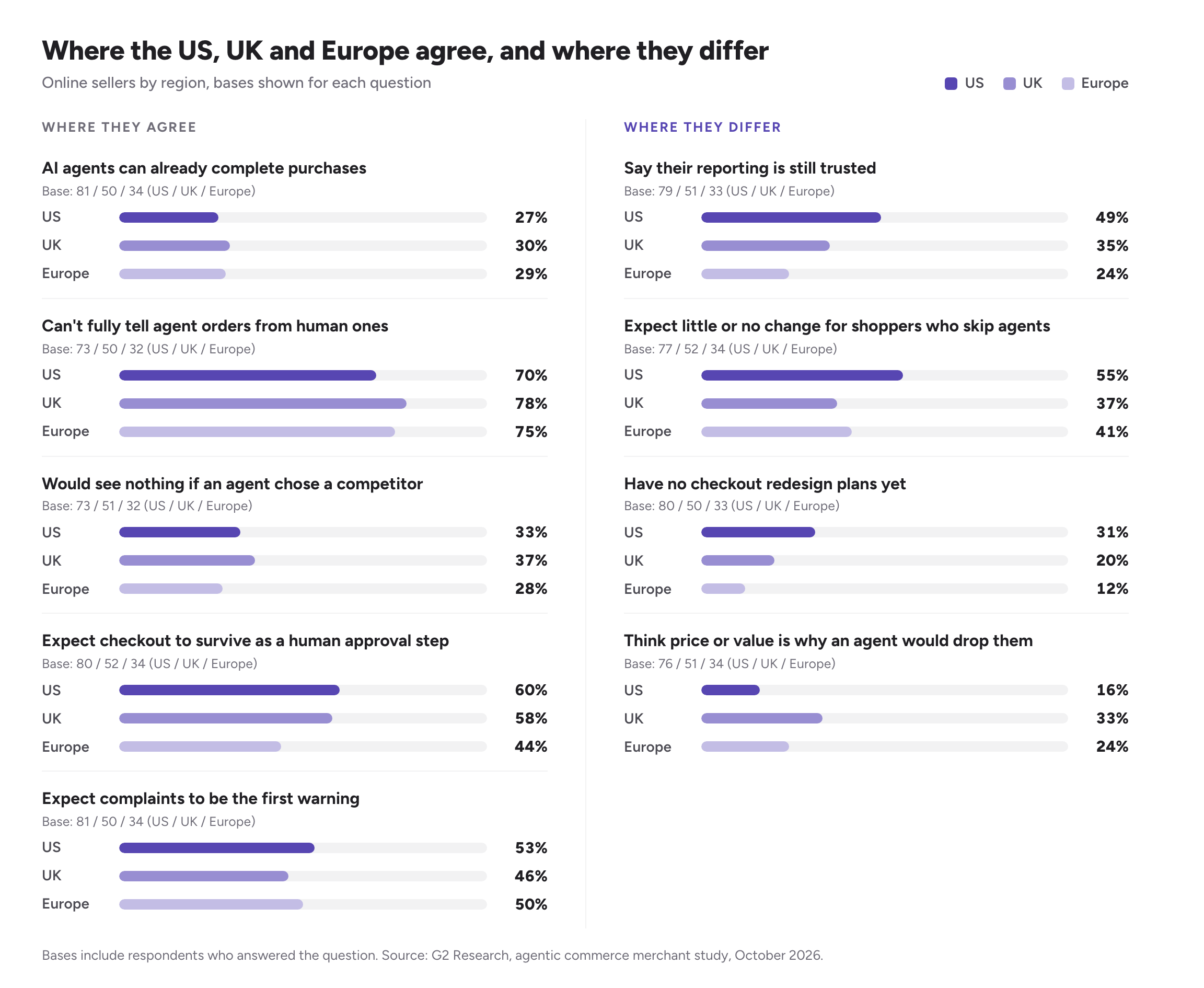
The gap runs in the same direction across several questions about urgency. Half of US merchants (49%) say their reporting is still trusted as agents arrive, against 35% in the UK and 24% in Europe. More than half of US merchants (55%) expect people who keep shopping without agents to notice little or no change, against 37% in the UK and 41% in Europe, and 31% have no plans yet to redesign their checkout, against 20% and 12%. UK merchants are also the most worried about price: 33% think an agent would drop them on price or value, against 16% in the US and 24% in Europe.
Merchants selling across borders can treat agent readiness as one program: the same detection, measurement and checkout fixes apply in every market. What differs is urgency. US teams may need the strongest case that agents already affect them, while UK and European teams are readier to act.
34% of online sellers run checks they expect would stop an agent, yet only 2% think checkout friction could cost them an agent sale. List every CAPTCHA, fraud rule, one-time code and 3D Secure step a purchase passes through, and decide which should recognize a verified agent acting with the customer's permission and which must always stop and ask a person. Ask your payment provider how it will handle agentic payments and verify that an agent really acts for the customer. Reviewing your fraud protection and payment gateway settings with this question in mind is the quickest place to start.
Only 12% of merchants with agent purchases live can reliably tell an agent order from a human one, and a third (34%) would see nothing when an agent walks away. Tag agent traffic wherever your tools allow, then log the agent sessions that fail and where they stop.
56% expect checkout to survive as a moment of human approval. Design one clear, secure confirmation, the heart of the agentic checkout, and remove the form-filling around it.
Positioning is what merchants most expect agents to misread (24%). State plainly why you cost more, what makes the product different and what the customer gets, and back it with structured product data, which shapes how AI agents read websites. Then test the prompts customers type into AI shopping assistants to see how agents describe you.
The most common answer on ownership came from only 20%, and 51% expect a complaint to be their first warning. Give one team the job of monitoring agents acting for you and for your customers, with signals that arrive before the complaint does.
Agentic commerce is online buying where an AI agent, sometimes called an AI shopping assistant, finds, compares and pays for products on a person's behalf. In G2's October 2026 study, 29% of online sellers said agents can already complete purchases with them, and another 8% were testing it.
Most can't do it reliably. In G2's 2026 interviews with 169 online sellers, 49% said their analytics can't separate agent traffic or purchases from human ones, 25% can do it partly, and only 12% can do it reliably. The share is no higher among merchants that already let agents buy.
Merchants don't expect a full replacement. In G2's 2026 study, 56% of online sellers expect checkout to survive in some form with a human confirmation step and security checks, 14% expect wallets, passkeys or platform checkouts to take over, and 4% expect fully automated agent-to-agent payments.
Not soon, according to merchants. Only 9% of online sellers G2 interviewed in 2026 expect cart abandonment to fade or turn into agent-specific metrics within two years, and 10% expect that in three to five years or more. A majority (54%) say human shopping metrics will stay essential alongside new agent metrics.
Often the merchant's own security. In G2's 2026 study, 34% of online sellers named a bot check, CAPTCHA, fraud rule or authentication step such as 3D Secure that they expect would stop an agent at checkout. Only 2% expected checkout or payment friction to be the reason an agent passes them over.
Merchants are betting on reputation. In G2's 2026 study, 33% of online sellers think established reputation and verified reviews would make an agent pick them, 13% point to structured product data and AI search visibility, and 64% say losing brand visibility to an agent would matter to their business.
There is no agreed owner. Asked who would own a bad experience spread across several AI tools, online sellers in G2's 2026 study split between shared cross-functional ownership (20%), e-commerce teams (17%), customer service (16%) and leadership or payments teams (10%).
They face the same blind spots but feel different levels of urgency. In G2's 2026 study, online sellers in all three regions gave similar answers on agent adoption, detection and the future of checkout. US merchants were the calmest: 49% said their reporting is still trusted, against 35% in the UK and 24% in Europe, and 31% had no checkout redesign plans yet, against 20% and 12%. UK merchants were the most likely to expect an agent to drop them on price or value (33%).
Agentic commerce: an AI agent finds, compares and pays for products on a person's behalf. Online sellers: the 169 respondents whose companies sell to customers online, the base for every statistic. Agent abandonment: an AI agent looks at a merchant and buys elsewhere, leaving no cart behind. Cart autonomy: an agent assembles and pays for a basket within limits the shopper set in advance, so the cart is never abandoned in the old sense. Reliably identify: analytics that separate agent orders from human ones through custom tracking, as opposed to partial bot or referral signals.
Merchants most want two things they can't see today: where agent traffic comes from and what the shopper asked for (28%), and why an agent dropped them or chose a competitor (25%). Today 59% mainly track conversion and cart abandonment, and 6% track AI search visibility.
Sponsored
Paysafe is a global payments platform built for the experience economy. We connect businesses, consumers, and fans across iGaming, video gaming, esports, events, travel, hospitality, online trading and digital commerce, helping lift everyday and high-engagement experiences through reliable payment solutions. These include card payments, digital wallets such as Skrill, PaysafeWallet, eCash products like PaysafeCard, and a broad set of local payment methods. With approximately 2,800 employees across 12 countries and $167 billion in annualized volume in 2025, Paysafe focuses on making digital experiences easier to access and pay for. More information is available at www.paysafe.com.
This research was commissioned by Paysafe. G2 maintains full editorial independence.

For this agentic commerce report, G2 conducted 206 AI-moderated voice interviews between October 5 and 25, 2026, with e-commerce, digital commerce, customer experience, product and payments leaders at companies in the US, UK and Europe. Three independent research panels recruited respondents, targeting director-level and above leaders in retail and e-commerce, travel and hospitality, gaming and entertainment, and iGaming. Interviews averaged 20 minutes (10 to 45 minutes) and followed a structured guide of 26 questions on agentic purchasing and the future of online checkout. All 197 respondents with panel screener records were at director level or above (head of function, director, VP, C-suite or founder), and half (49%) are C-suite executives, founders or VPs. Among the 169 online sellers, 52 work at companies with more than 1,000 employees and 16 at companies with more than 10,000.
Statistics in this report use the 169 respondents whose companies sell to customers online. We set aside 37 respondents whose companies aren't online merchants: businesses that sell through consulting, invoicing or in person, technology and payment providers, consultants describing a client's business, and brands that sell only through retailers or distributors. Each chart states its base, which excludes people who didn't answer that question.
G2 Interviews grouped open answers into categories with AI-assisted analysis, and G2's research team reviewed the coding and every quote against the transcripts. Quotes are lightly edited for readability: we removed filler words such as "um" and "uh", false starts and repeated words, added punctuation and corrected obvious transcription errors, without changing what respondents said. They are attributed by role, industry and company size. Just over half of the 169 (54%) work at companies with up to 250 employees, answers are self-reported, and no figure in this report rests on fewer than 30 respondents.
Regional comparisons are based on panel screener records of each respondent's country: US 82, UK 52 and Europe 34 (Germany 17, Denmark 5, Netherlands 3, Sweden 3, Norway 2, Italy 1, Finland 1, Switzerland 1 and Ireland 1).
This article was originally published in November 2026 and updated in November 2026.
G2 is the world's largest and most trusted software marketplace.
Commission Research
Partner with G2 Research on an original study built from real buyer interviews and structured for AI citation.
Explore more original research, selected from our latest reports.
Agentic voice AI in 2026: G2 interviewed 359 leaders. 82% of live deployments report positive ROI, 92% run with high or partial autonomy.
80% of enterprise commerce orgs are adopting AI. G2's 2026 study of 100 leaders reveals strategies for personalization and platform modernization.
G2 research with 100 UK business decision-makers finds 77% run largely disconnected software estates, 90% flag security exposure, and only 7% can quantify AI ROI.